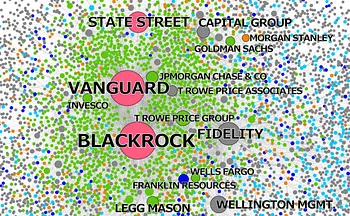
Imagine an invisible entity, devoid of any political seat and elected by no citizen, that holds the command keys to every strategic sector of your daily existence. This entity indirectly decides the price of the food you eat, which medicines will cure you, what car you will drive, which news you will read on social networks, and even which weapons will be produced to fuel global conflicts. This is not the plot of a dystopian novel by George Orwell, nor a conspiracy from a spy thriller. It is the structured, documented, and verifiable reality of the global economy in 2026.
At the center of this system operate just three actors: BlackRock, Vanguard, and State Street. Collectively known as the "Big Three", these asset management giants control over $30 trillion in assets. To grasp the scale of this figure, it exceeds the Gross Domestic Product (GDP) of the United States, China, and Japan combined. However, the truly alarming data lies not in the sheer financial size, but in the capillary pervasiveness of their control. Through a sophisticated mechanism of "common ownership," these three firms have become the top institutional shareholders of almost every major corporation listed in Western markets, effectively transforming the free market into an oligopoly managed centrally by a narrow financial elite based in New York and Boston.
The Death of the "Invisible Hand" and the Birth of the Central Planner
For over two centuries, Western economics has founded its legitimacy on the metaphor of the "invisible hand," coined by the Scottish philosopher and economist Adam Smith in his seminal work "The Wealth of Nations" (1776). According to this theory, competition among entrepreneurs driven by self-interest would inadvertently but effectively lead to maximum welfare for the entire community, lowering prices and stimulating innovation.
Today, that invisible and decentralized hand has been replaced by a "visible hand," extremely concrete and centralized. Regulatory data filed with the SEC (Securities and Exchange Commission) of the United States shows that BlackRock, Vanguard, and State Street collectively hold between 20% and 25% of the voting rights in almost every company composing the S&P 500 index. In a system where share ownership is fragmented among millions of passive small investors, a voting block of 20-25% equates to de facto control. One does not need an absolute majority to dictate terms; being the coherent reference shareholder is enough to appoint boards of directors, approve colossal mergers, and determine global strategies.
This concentration violates the fundamental premise of Smith: competition. When the same entity is the top shareholder of both Coca-Cola and PepsiCo, of ExxonMobil and Chevron, of General Motors and Ford, the incentive to compete aggressively on prices vanishes. Why destroy a competitor if both belong to the same portfolio? The result is "domesticated competition," where prices remain artificially high and disruptive innovation is often curbed to protect the stability of sector profits.
The Energy Empire: Between Green Rhetoric and Black Coal
One of the most evident paradoxes of this system concerns the energy sector. The public narrative of these giants, led in particular by Larry Fink, CEO and founder of BlackRock, has for years focused on sustainability and the fight against climate change. Fink has repeatedly declared in his annual letters to investors that "climate risk is investment risk," pushing for the massive adoption of ESG (Environmental, Social, and Governance) criteria.
However, financial data tells a radically different story. While launching funds labeled as "sustainable" or "low carbon," the Big Three continued to increase their stakes in the largest fossil fuel companies on the planet.
- In the oil sector, they hold decisive stakes in ExxonMobil, Chevron, Shell, and BP, collectively controlling over 20% of the capital of each.
- In the coal sector, the situation is even more critical. According to court documents from a 2025 antitrust lawsuit, BlackRock, Vanguard, and State Street jointly held approximately 30-34% of the two largest US coal producers: Peabody Energy and Arch Resources.
This dual position has attracted the attention of federal authorities. In 2025, the US Department of Justice (DOJ) and the Federal Trade Commission (FTC) filed official statements of interest in a multi-state lawsuit led by the Attorney General of Texas, Ken Paxton. The authorities accuse the three managers of forming an illegal cartel to coordinate and artificially reduce coal production, not for environmental reasons, but to manipulate energy prices to the advantage of other sectors in their portfolios Source: Federal Trade Commission.
Meanwhile, investigative reports such as those by the Guardian have highlighted how these managers continued to finance fossil expansion even during the peaks of their climate rhetoric, recording record profits thanks to the rise in energy prices they themselves helped generate Source: The Guardian. The saga concluded in 2025 with Vanguard paying $29.5 million to settle these charges, while BlackRock and State Street continued to fight in court, defining the accusations as "absurd" Source: NYU Stern Center.
The Military-Industrial Complex: Owning War
If the energy sector shows contradictions regarding the environment, the defense sector reveals the deep nature of the Big Three's power: the ability to profit regardless of peace or war. The three giants are the top institutional shareholders of all major Western defense companies, the so-called "Primes."
- Lockheed Martin: Producer of the F-35 fighter jet and advanced missile systems. The Big Three collectively control over 22% of the company.
- RTX Corporation (formerly Raytheon): Manufacturer of Patriot air defense systems and numerous missiles. Combined ownership exceeds 20%.
- Northrop Grumman: Responsible for the B-21 Raider strategic bombers and the renewal of the US nuclear triad.
- Boeing: Beyond civil aviation, it is a pillar of US defense (F-15, F-18 fighters, Apache helicopters).
Presence extends to Europe, where BlackRock and Vanguard are among the main shareholders of Airbus (missiles and military aeronautics) and Rheinmetall, the German tank giant (Leopard), whose shares have skyrocketed with the continent's rearmament.
This structure creates a systemic conflict of interest: the same funds that advertise "socially responsible" products draw direct profits from the production of weapons used in conflicts in Ukraine, the Middle East, and elsewhere. There is no real ethical divestment; there is only risk management that balances stakes between those who produce weapons and those who rebuild the rubble, maximizing returns in every geopolitical scenario.
The Food Chain and Health: From Seed to Pharmacy
The influence of the Big Three penetrates even the most intimate aspects of human life: what we eat and how we are cured.
In the agri-food sector, their presence is vertical and dominant. They control relative majority stakes in Bayer (which owns the former Monsanto), Corteva Agriscience, and Nutrien, effectively holding the keys to the global market for seeds, pesticides, and fertilizers. They move down the chain to commodities traders like Archer-Daniels-Midland (ADM) and Bunge, which move the world's wheat and soy, to arrive at distribution giants like Walmart, Costco, and Amazon. This integrated ownership allows them to influence global food prices and crop choices, favoring intensive monocultures and GMOs that guarantee stable volumes and profits, at the expense of biodiversity and local agriculture.
In the pharmaceutical sector, the situation is specular. BlackRock, Vanguard, and State Street are the top shareholders of Pfizer, Johnson & Johnson, Merck, Novartis, and Roche. The theory of "common ownership" suggests that this structure reduces the incentive to compete on drug prices. Why lower costs to gain market share if you already own all competing companies? The result is a system that protects patents, keeps prices high, and directs research towards profitable chronic drugs rather than cures for rare diseases or basic antibiotics, which are less profitable but socially crucial.
Technology and Information: The Guardians of Truth
Perhaps the most critical sector for the future of democracies is communications and technology. The Big Three are the main shareholders of Apple, Microsoft, Alphabet (Google), Meta (Facebook), and Amazon.
- In Google and Meta, they control about 20-24% of the capital, exerting constant pressure on content moderation policies.
- In Microsoft and Apple, they hold similar stakes, influencing the development of Artificial Intelligence and the cloud infrastructures that support the global digital economy.
This concentration raises profound questions about freedom of expression. As shareholders of all major platforms, the stewardship teams of these funds have the theoretical power to coordinate censorship or content visibility policies on a global scale, homogenizing public discourse according to corporate standards "safe for advertisers," often aligned with specific political or social agendas. No government order is needed to censor; an internal guideline from a fund that owns 20% of every platform is enough.
The Verdict of the Giants of Economic Thought
Faced with this scenario, how would the founding fathers of modern economics react? The analysis suggests a unanimous condemnation, albeit with different nuances.
1. Adam Smith and the Horror of the Cartel For Adam Smith, this situation would represent the absolute negation of competitive capitalism. Smith explicitly warned that "people of the same trade seldom meet together... without the conversation ending in a conspiracy against the public." The Big Three have institutionalized this conspiracy through cross-ownership, eliminating the competition that is the sole engine of consumer welfare. Smith would see in this system a return to the worst mercantilism, where the privileges of the few stifle innovation and plunder the public.
2. John Maynard Keynes and the Danger of Rent John Maynard Keynes would distinguish between the entrepreneur who creates wealth and the "rentier" who lives off financial income. The Big Three represent the apotheosis of the Collective Super-Rentier: they extract commissions and dividends from every global economic transaction without assuming direct entrepreneurial risk (which remains with the savers) and without creating real productive value. Keynes would see in this concentration a source of systemic fragility and social injustice, where finance has completely absorbed and directed the real economy, likely calling for state intervention to treat these giants as "public utilities" to be strictly regulated.
3. John Kenneth Galbraith and the Technostructure John Kenneth Galbraith, with his theory on the "Technostructure," would be the least surprised but the most severe. For Galbraith, power in large corporations has passed from owners to technical managers. The stewardship teams of BlackRock, Vanguard, and State Street are the final evolution of this technostructure: an unelected elite that plans the global economy not for the public good, but for the stability and growth of its own organization. The instrumental use of ESG would be for Galbraith the definitive proof of how this elite builds a facade of moral legitimacy to protect its absolute power, neutralizing any possible "countervailing power" (unions, states, consumers) since it sits at all decision-making tables simultaneously.
Conclusion: Towards a New Financial Feudalism?
The definition of a "Capitalist Supreme Soviet" is not hyperbole, but an accurate technical description. We have witnessed the birth of a private command center that plans the global economy with an efficiency that Soviet planners could only have dreamed of, but without any democratic accountability.
This system does not answer to voters, does not answer to consumers (since competition is domesticated), and does not even fully answer to the savers whose funds it manages. It answers only to the internal logic of its own growth and stability. Whether it involves pushing for diversity on boards, curbing coal production, financing new wars, or controlling the flow of information, the result is always the same: the priority is the return of the Big Three's portfolio.
The free market, as theorized for 250 years, may have already ended, silently replaced by a centralized management of the world economy in the hands of just three actors. The question that remains open, and which should worry every citizen, politician, and entrepreneur, is: is there still a mechanism to control the controllers? Or have we already entered a new era of financial feudalism, where the sovereignty of nations and the freedom of markets are merely retrospective illusions?
Verified Sources and Further Reading:
- Institute of Business & Finance: BlackRock, Vanguard, State Street: The Big Three Explained
- Federal Trade Commission (FTC): FTC and DOJ File Statement of Interest in Energy Collusion Case Against BlackRock, State Street, and Vanguard
- The Guardian: World's top three asset managers oversee $300bn fossil fuel investments
- Proactive Investors: BlackRock, State Street and Vanguard sued by Republican states for coal 'cartel' agenda
- NYU Stern Center for Business & Human Rights: Vanguard Settles on ESG — BlackRock and State Street Fight On
- Reuters: US supports Republican states' argument in BlackRock climate case
- Wikipedia: Adam Smith
- Wikipedia: Invisible hand
- Investopedia: Top Lockheed Martin Shareholders
- The Bureau Investigates: BlackRock ploughed UK pension funds into Putin's war chest
Drafted with the support of EURIA AI


Nessun commento:
Posta un commento